A system of bodies, simulated under the influence of physical forces.
Simulation
[ galaxy ][ solar system ]
Features
Newtonian gravitational force calculation between bodies
Euler
and
Leapfrog (Störmer-Verlet)
integration implementations
Config-driven body loading from JSON
Pygame rendering with motion-blur orbit trails
Decoupled physics and rendering threads via
threading.Lock to isolate the Pygame render-viewport
frame-rate from the physics integration pass
Gravitational softening (ϵ)
to prevent force
singularities
during close encounters
Body collision detection with momentum-conserving merges
Random N-body generation with
coherent prograde velocity distribution (v = √(GM/r))
Camera and zoom system for navigating large simulations
Barnes-Hut O(N log N) spatial partitioning for gravitational force
approximation
NumPy vectorized force calculations eliminating per-pair Python object
overhead
Pytest coverage for gravitational force, orbital regression, and
momentum conservation
Benchmark scripts for orbital period measurement and integrator
comparison
How it works
[ 01 ]
Vector3D
Position, velocity, and force represented as 3D vectors for every
body.
[ 02 ]
Barnes-Hut Octree
Distant clusters of mass are approximated instead of compared
body-by-body, cutting complexity to O(N log N).
[ 03 ]
NumPy Vectorization
Gravity calculations run as batched array operations instead of
Python loops.
[ 04 ]
Threading
Physics and rendering run on separate threads, keeping the
simulation smooth as N grows.
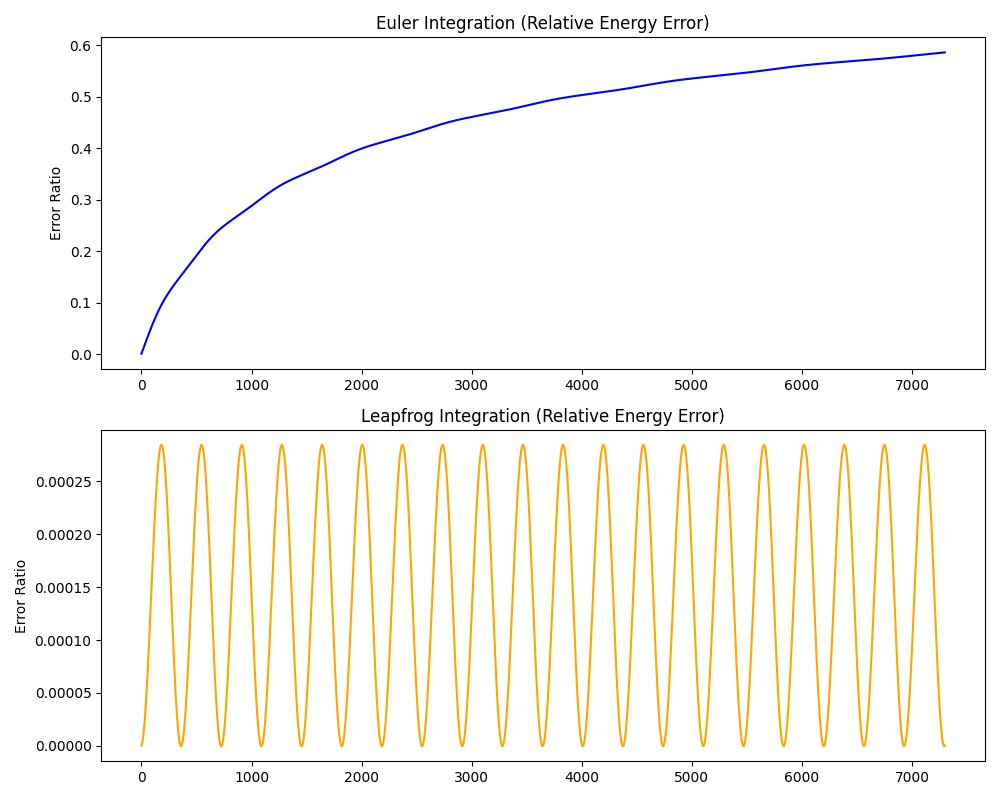
Numerical Integration
Leapfrog (Störmer-Verlet) integration
was chosen over
Euler
because it is
symplectic, it preserves the
geometric structure of Hamiltonian systems, keeping orbital energy bounded rather than drifting over time.
60%Euler
energy error (20-year horizon)
0.03%Leapfrog
energy error (20-year horizon)
Gravitational force is
softened
near close encounters (F = Gm₁m₂ / (r² + ε²)^1.5) to prevent
singularities
as r → 0, bounding the maximum force at small separations while
preserving accuracy at larger distances.
Orbital Accuracy
Orbital periods were validated against the NASA Planetary Fact Sheet by
tracking cumulative angular displacement (2π radians) relative to the
Sun using the
Leapfrog
integrator.
Body
Target Period (days)
Simulated Period (days)
Error (days)
Accuracy
Mercury
87.97
87.96
0.01
99.99%
Venus
224.70
224.12
0.58
99.74%
Earth
365.26
364.92
0.34
99.91%
Mars
686.98
686.12
0.86
99.87%
Jupiter
4,332.59
4,332.12
0.47
99.99%
Saturn
10,759.22
10,720.96
38.26
99.64%
Uranus
30,688.50
30,277.46
411.04
98.66%
Neptune
60,182.00
59,518.08
663.92
98.90%
Reference: NASA Planetary Fact Sheet
Performance
Method
Time (N=500, 50 steps)
Relative Speed
Barnes-Hut pure Python
100.1s
3x slower
O(N²) pure Python
33.07s
baseline
NumPy vectorized
0.835s
39.6x faster
Barnes-Hut underperforms at N=500 due to pure Python tree construction
and recursive traversal overhead, expected at low N. NumPy vectorization
wins at this scale by replacing per-pair Python object allocation with
vectorized operations in compiled C. A NumPy + Barnes-Hut hybrid is the
planned next step to reach the particle counts where Barnes-Hut's O(N
log N) advantage dominates.
Benchmarked on Python 3.14 · Intel i5-14400F · Windows 11 Pro